
Amp up Your Fermentation Game with All Natural Nigari
Seawater, Salt, and the Origins of Lactic Fermentation
It’s no coincidence that most lactic fermentation recipes call for a salt concentration between 2.5–3.5%—the same salinity range as the ocean.
For most of human history, fermentation wasn’t performed with salt dissolved into freshwater. It was performed with seawater itself.
Along coastlines around the world, seawater offered a ready-made fermentation medium: naturally saline, mineral-rich, and biologically compatible with lactic acid bacteria. In coastal Korea, this tradition persists today—some regional kimchi is still made using seawater rather than a recreated brine.
The modern practice of dissolving salt into freshwater likely arose from necessity. Transporting seawater inland is impractical; transporting salt is not. But as is often the case, convenience came at a cost.
Our research suggests that something essential was lost in the transition.
Revisiting a Traditional Method
Several years ago, we decided to test the original approach.
We filtered and concentrated Pacific seawater to a 3% salinity, then shared it with a small group of fermentation professionals—people who ferment for a living and have refined palates.
The response was immediate and unanimous.
The seawater ferments were described as the best they had ever produced, with noticeably improved texture and flavour clarity. Most strikingly, the results were judged superior even to ferments made using our own all-natural sea salt.
That prompted a deeper question:
What is seawater providing that salt alone cannot?
More Than Sodium Chloride
Seawater is often thought of as salt and water. In reality, it is a complex mineral solution.
Beyond sodium chloride (NaCl), seawater contains a broad spectrum of dissolved minerals. Among the most important for fermentation are magnesium, potassium, and calcium.
These minerals are not incidental. Scientific literature has shown that certain strains of lactic acid bacteria benefit from elevated levels of magnesium and potassium. For example, Streptococcus faecalis is known to thrive in potassium-rich environments (MacLeod & Snell, 1947).
This helps explain a long-standing observation among fermentation practitioners:
the best ferments are almost always made with unrefined sea salt, not industrially refined salt.
Why Sea Salt Matters — and Why It Still Falls Short
Refined salts such as kosher salt are stripped of trace minerals and commonly contain anti-caking agents. These additives serve an industrial purpose, not a biological one.
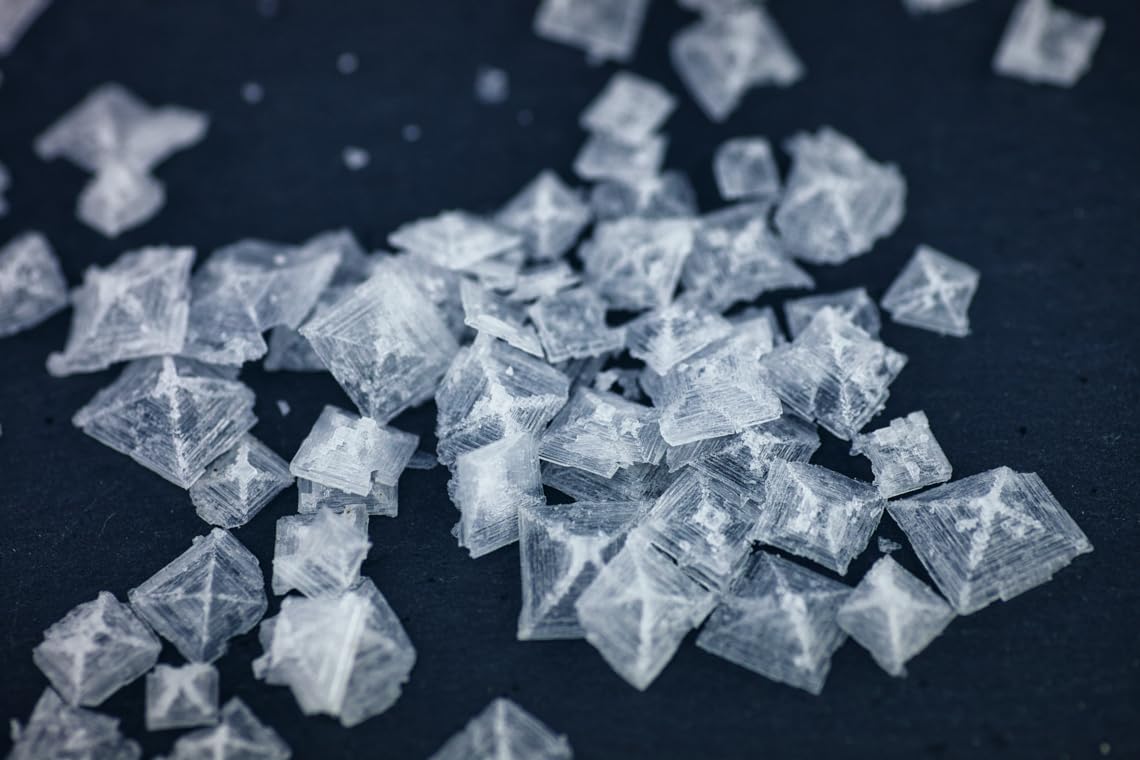
All-natural sea salt, by contrast, retains a portion of the ocean’s mineral profile and contains no additives. As a result, it produces more flavourful, texturally stable ferments.
But even the best sea salt is still an approximation of seawater—not a match.
Why? Because magnesium- and potassium-rich salts are the last to crystallize during salt harvesting. After sodium chloride precipitates, these minerals remain dissolved in the concentrated brine left behind.
That residual brine is where the ocean’s complexity lives.
Nigari: The Missing Fraction
In 2018, we began capturing and bottling this mineral-rich brine.
In the salt world, it’s known as Nigari—from the Japanese word for bitter, a flavour that reflects its high magnesium content. Traditionally, Nigari is used as a tofu coagulant.
We saw another application.
By adding a small amount of Nigari to a fermentation brine made with all-natural sea salt, it becomes possible to restore much of the mineral balance of seawater—particularly magnesium and potassium—without sourcing seawater itself.
Because Nigari is highly concentrated, only a very small amount is required.
Texture, Flavour, and Proof in Practice
To test the theory, we collaborated with Brad Hendrickson of Biota Fermentation in Vancouver.
Brad prepared multiple batches of sauerkraut at 2.5% sea salt salinity. One batch served as a control. The others included Nigari additions ranging from 0.25% to 0.4%.
In blind sensory testing, participants consistently preferred the Nigari-enhanced batches—citing improved texture and greater flavour depth. Preference increased with higher Nigari concentration within the tested range.
Further testing with Chef Nick Cassetari of Whistler’s award-winning Alta Bistro produced similar results.
“We started using Nigari in our ferments and it’s safe to say we will not stop using it. The texture and purity of flavour is paramount.”
— Chef Nick Cassetari
Why It Works
Fermentation is complex, and no single variable explains everything. But several mechanisms are likely at play:
-
Magnesium and potassium chlorides are salts, contributing to vegetable firmness and structural integrity—much like sodium chloride.
-
Unlike NaCl, these salts are bitter rather than salty, improving texture without increasing perceived saltiness.
-
The added bitterness subtly offsets salinity, increasing overall flavour complexity.
-
While Nigari does not appear to increase total LAB activity (final pH levels remain comparable), elevated trace minerals likely shift the bacterial profile in ways that favour flavour and texture.
This is an active area of ongoing study, and we plan to publish more findings as our research continues.
A Living System, Not a Recipe
Our interest in Nigari was reinforced by a story recounted by Mark Bitterman in Salted, describing an experiment by salt maker Odo:
Crabs placed in water made with refined salt died almost immediately.
Crabs placed in water made with unrefined rock salt survived only days.
Crabs placed in water made with natural sea salt lived—and the aquarium itself began producing new life.
The implication is simple and profound:
the subtle chemistry of seawater matters.
Not just for marine life—but for fermentation, flavour, and food that is truly alive.